I have combined my passion for photography with my passion for the great outdoors and all of its amazing creatures and creations.
Tuesday, July 29, 2014
Maple Callus Borer
Juicy Tidbits
Is a clearwing moth.
Has a notable red tuft at the tip of its abdomen.
Host for these moths are maple trees. Trees can be significantly damaged over time by the larvae. Silver, Red and Sugar Maples are favourite host trees.
Found throughout North America.
Moths fly from April to August.
Check out these sites for more information on the Maple Callus Borer:
Bugwood Wiki: http://wiki.bugwood.org/Archive:Borers/Synanthedon_acerni
Bug Guide: http://bugguide.net/node/view/10962
North American Moths blog: http://moths.wordpress.com/2010/04/01/maple-callus-borer/
Butterflies and Moths of North America: http://www.butterfliesandmoths.org/species/Synanthedon-acerni
Sunday, July 20, 2014
Fishfly
This fishfly I have determined to be a male, as it has very feathery antennae. Antennae of the females are more beadlike. Because of the feathery antennae, I also believe this fishfly to be in the genus Chauliodes. The larvae of this fishfly live in still waters, as opposed to the running waters of rivers and streams.
You can click on the photos for a closer look!
Lucky for me this fella was very brave and patient. I thought for sure he'd fly away when I put my finger in for a perspective shot, but he didn't. Thanks big guy! I'd put the size of this fishfly at a little over 2 inches from head to wingtip.
A fly popped in for a little visit to help show the large size of this fishfly.
You can see here that fishflies have not just two eyes, but five. Two are compound eyes (eyes with multiple lenses), but the other three that you see on the top of its head are simple eyes which only have one lens. The three simple eyes here all point in a different direction, which I suspect help aid the fishfly in avoiding hungry predators.
Take a closer look at the cool mandibles of this fishfly. Most of the reading I have done indicates that the adult fishfly doesn't feed or eats very little. The mandibles could be used for self-defense from predators as well as during the mating process. I have also been unable to determine if they bite. I have read that the larvae can bite, but have found no information on the "biting" status of adults.
Juicy Tidbits
Fishflies are part of the Megaloptera order, which also includes alderflies and dobsonflies. The order name means "ample wings".
Dobsonflies and fishflies are part of the family Corydalidae.
When in the aquatic larval stage, the larvae feed on other insects like black fly larvae.
Adults eat little or nothing at all.
I believe this specimen is Chauliodes pectinicornis, which is commonly known as the summer fishfly.
The aquatic larval stage of the fishfly can last up to 2 - 3 years.
Adults typically only live for a few days, just enough time to mate and lay eggs.
Male fishflies have feathery antennae, the female fishfly antennae are more beadlike.
Life cycle is that of complete metamorphosis: egg ~ larva ~ pupa ~ adult.
Body size 21 - 46 mm (0.8 inches to 1.8 inches) not including wingspan.
For more information on the fishfly, check out these amazing sites:
Insect Identification. org -- http://www.insectidentification.org/insect-description.asp?identification=Fishfly
Bioweb Home -- http://bioweb.uwlax.edu/bio210/s2012/bauer_jona/
Bug Guide. net -- http://bugguide.net/node/view/8568
Saturday, July 19, 2014
Painted Lichen Moth
Here are some of the photos I was able to capture before it flew away....
For more information on the Painted Lichen Moth, check out these great sites:
http://en.wikipedia.org/wiki/Hypoprepia_fucosa ~ Wikipedia
http://bugguide.net/node/view/16271 ~ Bug Guide
http://awaytogarden.com/lichen-moths/ ~ A Way to Garden
Sunday, June 1, 2014
Cicada Exuvia
Tuesday, October 8, 2013
Single Red Autumn Vine
The beauty of Autumn is upon us and can easily be found anywhere right now. You don't have to travel far to find the amazing colours that Fall brings. Head down to the lake, take a walk in the woods or simply look in your backyard. I'm sure you'll see some amazing colours that are sure to soothe your soul.
I've been admiring these vines that have crept over my fence from my neighbour's place. I hope you enjoy them as much as I do!
Now get oustide and enjoy some nature!
Friday, September 6, 2013
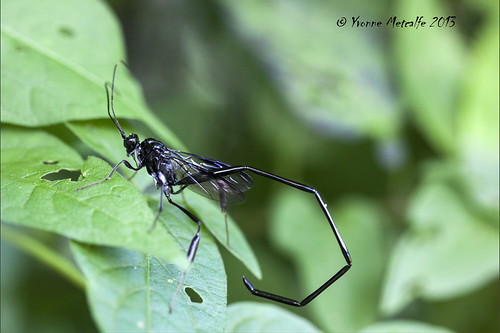
American Pelecinid Female
This beautiful stingless wasp was found at the Earl Rowe campground in Alliston, Ontario. It was at least 1 1/2 inches in length (that includes the tail) if not more. I have never encountered one of these before, so was quite thrilled to capture it!
The male pelecinid wasp is quite rare. What's interesting about this wasp is that the females are able to reproduce without the help of the male. This type of reproduction is called parthenogenisis, which means "virgin birth" . This simply means that the female can lay eggs that don't require fertilization. These unfertilized eggs hatch more females, which explains why this species is predominantly female. For more info on this process, check out this site: http://bioweb.uwlax.edu/bio210/s2012/brummond_jord/reproduction.htm
Monday, September 2, 2013
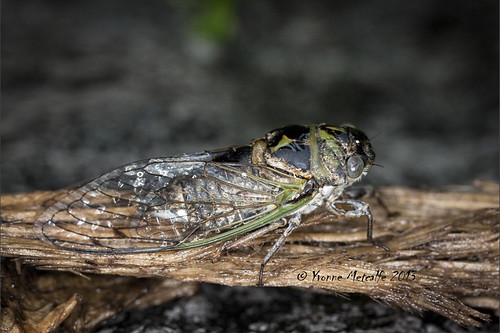
Dogday Harvestfly on Wood
The Dogday Harvestfly (Tibicen canicularis) is a type of cicada. This one was found in my friend's backyard here in Barrie. Including its wings, it was about 1 1/2 inches in length (about 40 mm).
These creatures cannot sting or bite. It is believed that the dogday harvestfly doesn't even eat. They live underground as wingless nymphs for two to five years.There, they feed on root juices until they are ready to become adults. When ready, they emerge from the dark underground, climb the nearest plant and molt their skin. Once they have climbed out of their skin and their wings have dried, they make their way to the treetops to look for a mate.
You can hear the male cicadas singing in the summer ~ this is how they find their mates!Their call sounds like a circular saw cutting through wood.
I love it when I'm able to photograph these amazing creatures.... they are hard to find (eventhough I hear them all the time).
If you would ever like to find a cicada, the best way to do so is to look on the trunks of trees during the summer. If you are lucky, you might be able to find their empty skin shells (called exuvia). If you this, just look up the tree and see if the freshly emerged cicada is still there. I was lucky enough last year to find four emerging cicadas on a tree as Bass Lake, Ontario. What a thrill that was to watch and photograph!
You can check out my Emerging Cicada post from July 22, 2012 to see pictures of cicada nymphs transforming into adults. Very cool!
Tuesday, August 13, 2013
Milkweed Tussock Moth Caterpillars
I only managed a couple of shots before they fell off the leaf they were on. This is apparently a defense mechanism they use when they feel threatened. My son had bumped the plant they were on and they quickly curled up and dropped to the ground.
The caterpillar will eventually become the Milkweed Tussock Moth (or Milkweed Tiger Moth).
Check out some of these sites to learn more about the Milkweed Tussock Moth and their caterpillars:
Garden Web: http://forums.gardenweb.com/forums/load/butterfly/msg0907431211368.html
Wikipedia: http://en.wikipedia.org/wiki/Euchaetes_egle
The Metropolitan Naturalist:
http://metro-naturalist.com/Animals/Insects/Milkweed_Tussock_Moth.html
Monday, June 3, 2013
Eight-spotted Forester Moth
Not knowing how cooperative it would be, I took a few shots for identification purposes, and then I attempted to pick it up. Turned out that this moth was in a photogenic mood. I love it when they cooperate!
![]() |
| Don't forget.... you can click on the picture to view me LARGE! |
- Found in the Eastern part of the U.S., Texas and Florida, as well as some parts of Canada
- Found along woodland egdes, in vineyards and in cities
- The adults fly in bright daylight, and this moth is often confused for a butterfly
- Wingspan is about 30 to 37 mm
To learn more about this beautiful moth, check out the following sites:
http://www.butterfliesandmoths.org/species/Alypia-octomaculata: Butterflies and Moths of North America
http://en.wikipedia.org/wiki/Alypia_octomaculata: Wikipedia
Thursday, May 30, 2013
Snail with a Mite
Neat what interesting things you can find when you stop to notice the ordinary.
![]() |
| A mite has attached itself to this snail's optic tentacle which can also be referred to as a "feeler" |
Sunday, May 19, 2013
Trillium Bokeh
The trilliums were beautiful on my walk today! Some were starting to look a liitle tired already, so if you haven't been out to shoot these beauties, now is the time to do it.
The white trillium is the emblem and official flower of Ontario. It is also the official symbol for the Government of Ontario as well as the official wildflower of Ohio.
It is a common misconception that it is illegal to pick trilliums here in Ontario. This flower is only protected in provincial parks and on lands owned by conservation authorities. There is a rare drooping trillium which is, however, protected by law and illegal to pick. Picking a trillium does do a lot of damage to the plant, and it may take years to be able to flower again.
Instead of picking a trillium to have for a few days, take a picture of it instead and have it forever.
For more information, check out the following links:
http://en.wikipedia.org/wiki/Trillium ~ All about trilliums
http://en.wikipedia.org/wiki/Trillium_flexipes ~ Learn about the drooping trillium here
Saturday, September 22, 2012
Nature Gazing
Saturday, August 4, 2012
Bald-headed Blue Jay
![]() |
| This Blue Jay seemed normal and healthy in all other aspects... just missing all its head feathers! |
![]() |
| Click to enlarge the photos for a better view |
![]() |
| The head feathers should return within a couple of weeks
|
For more information on the bald Blue Jay, and other bald birds, check out the following links:
Bird Studies Canada: http://www.bsc-eoc.org/organization/newsarchive/9-16-05.html
Project FeederWatch: http://www.birds.cornell.edu/pfw/AboutBirdsandFeeding/BaldBirds.htm
The Zen Birdfeeder: http://wildbirdsunlimited.typepad.com/the_zen_birdfeeder/2010/08/bald-birds.html
HIlton Pond Center: http://www.hiltonpond.org/ThisWeek030701.html
Sunday, July 22, 2012
Emerging Cicada
![]() |
| The empty skin, or exuviae, of a cicada clings to the side of a tree |
The cicada is dear to me for a few reasons. First, their distinctive high pitched song reminds me of when I was a child and how I used to think their buzzing was actually the power surging through the power lines. Second, the cicada song to me means summer. When you hear that buzzing, you immediately think of a hot summer day, jumping in a lake and sipping lemonade. Well at least I do. Lastly, the cicada was the insect that rekindled my passion for insect identification, for nature and for photography. This happened about 10 years ago when we found a freshly molted cicada clinging to the tire of our car. I had never seen a cicada before and was instantly mesmerized. As a child, I was always fascinated by insects... I had forgotten that part of me as an adult. Today I embrace it, thanks to one little cicada that happened to cross my path a decade ago.
Now, I have already written about the cicada in this blog, so I don't really wish to repeat everything again. If you'd like more info on this amazing creature, check out my January blog from 2010: Cicadas: One of My Favourite Insects... http://naturenutlady.blogspot.ca/2010/01/cicadas-one-of-my-favourite-insects.html
Here are some shots of cicadas as they are emerging from their nymphal skins. Essentially, what is happening is that the cicada has pushed through the back of its shell and then slowly pulls itself out of its skin. As it slowly wiggles itself loose, it ends up sticking straight out from the tree so that it is parallel with the ground. When it is finally ready to complete molting, it curls forward and grabs the head of its now empty skin and then pulls its back end out of the casing. The cicada will then rest there while its wings slowly expand and dry. When rested enough, the cicada then slowly starts walking up the tree to where it lives its adult life.
I am not sure as to exactly what species these cicada are, but I have an i.d. request in with the experts at http://www.bugguide.net/
![]() |
| An emerging cicada slowly wiggles its way out of the back of its casing (exuviae). |
![]() |
| Fully emerged, the cicada still clings to its skin (exuviae) to rest and let its wings expand and dry |
![]() |
| I used my flash in this shot. |
![]() |
| A more cropped in version of the shot from above |
![]() |
| This one's wings are much greener than the previous one. Its wings have not fully expanded yet.
|
Sunday, June 3, 2012
Cedar Apple Rust: A Funky Fungus!
So this gelatinous, orange tentacled ball of goo turns out to be something called Cedar Apple Rust. It is caused by a plant pathogen known as Gymnosporangium juniperi-verginianae. This fungus occurs in any location where apples, crabapples and the Eastern red cedar coexist. It has a very interesting lifecycle, in which the disease starts on the cedar tree, spreads through spores to apple trees, and then the spores from the infected apple tree continue on to infect more cedar trees.
Here's a diagram form Wikipedia:

Here are some of the photos I took of this alien looking plant fungus. You can click on each photo for a bigger and better view!
There are a lot of websites out there with awesome information about this intruiging pathogen. Here are a few that I found:
Wikipedia: http://en.wikipedia.org/wiki/Gymnosporangium_juniperi-virginianae
Cornell University: http://www.nysipm.cornell.edu/factsheets/treefruit/diseases/car/car.asp
ON Ministry of Agriculture, Food & Rural Affairs: http://www.omafra.gov.on.ca/english/crops/facts/cedarap.htm#cedar
The Gardening Life Blog: http://shirley-agardenerslife.blogspot.ca/2012/05/cedar-apple-rust.html
Monday, May 7, 2012
Red Admiral Butterfly
![]() |
| The red admiral has some distinctive patterning that make them quite easy to identify. The males and females are similar looking. |
![]() |
| This one looks like it has escaped death a few times. The tears in the wings are most likely from birds. |
![]() |
| For fun, I played with my focus a bit to create this abstract.
Check out the following websites for more info on the red admiral and butterflies in general:
http://www.enchantedlearning.com/subjects/butterfly/allabout/Bflyormoth.shtml The difference between a butterfly and a moth
http://www.gardenswithwings.com/butterfly/Red%20Admiral/index.html Information on the red admiral
|
Friday, May 4, 2012
Pseudoscorpions
While taking some pictures of a particular red admiral, I noticed that it had a piece of fluff on its leg. I was actually a little disappointed, as I thought that it would detract from the photo I was attempting to make. I managed about five shots of it before it flew off, and then continued taking photos of all the other butterflies in the backyard.
Imagine my surprise (and joy!) when I downloaded my photos to my computer and discovered that the annoying piece of fluff (my over 40 eyes don't see like they used to!) was a fascinating little creature! I had a pretty good idea as to what it was, so with a little bit of googling I determined that this was a pseudoscorpion!
I am still researching this little arachnid, but for now, here are the...
- Ranges between 2 - 8 mm in length
- A predacious arachnid with venomous pedipalps to help it subdue its prey
- Related to the scorpion... harmless to humans and pets
- Beneficial to humans because they eat many other insects that are thought of as pests. This includes clothes moth larvae, carpet beetle larvae, ants, small flies, mites and booklice to name a few. And according to my photo, they perhaps eat butterflies as well
- They live in leaf litter, under rocks, under bark and within decaying wood
- They can end up in your home, but are harmless
- Are also know as a false scorpion or a book scorpion
![]() |
| A pseudoscorpion hitching a ride on a butterfly's leg. Click the photo for a larger view |
![]() |
| A cropped in version to give better detail of the pseudoscorpion
I am uncertain as to the fate of this butterfly. Was the pseudoscorpion simply hitching a ride, or has it found itself a scrumptious (and rather large) meal? If you know have any more information on this fascinating creature, please feel free to comment!
May 11th update: According to the good people at http://www.bugguide.net/, the butterfly will not fall victim to this little beast. The pseudoscorpion was indeed just hitchin' a ride! Thanks for the info Ken Wolgemuth
The following websites were used in gathering my information... Check them out for a better understanding of this incredible arachnid!
http://www.biology.ualberta.ca/bsc/news24_1/pseudoscorpions.htm by Chris Buddle
http://www.biology.ualberta.ca/bsc/news24_1/pseudoscorpions.htm The Canadian Encyclopedia
http://robhigginsblog.blogspot.ca/2009/04/pseudoscorpions.html by Dr. Rob Higgins
|
Wednesday, December 7, 2011
An Amazing Day at the Toronto Zoo
We went on Friday, December 2nd. It was a cool day, but the sun made an appearance or two throughout our visit. The best part was that zoo wasn't busy at all. There wasn't a school bus in the parking lot! A perfect day to take our time and get some shots of some amazing, beautiful animals.
![]() |
| Click on the picture to see even larger. I love the detail of its tiny teeth. |
![]() |
White Tree Nymph Butterfly. I could chase butterflies all day!
|
![]() |
| A guinea fowl. Looks like a cross between a decorative throw pillow, a turkey and a dinosaur with a crested head! |
![]() |
| This bird was staring me down! |
![]() |
| Snackus Interruptus |
The eyes on this little orangutan seemed quite sad.
|
| Mother and Infant having a nap ~ much like how I used to nap with my own children...
A couple shots of the tigers taken with my telephoto lens. There is a fogginess to parts of the pictures, as I had to shoot through the wire fencing.
The highlight of our day was easily the polar bear exhibit. Fortunately for us, the polar bears were up and about and feeling a little playful. I had hoped to catch a few under water shots, but all the playfulness was happening on land today.
What a great day of animal watching and photography. I could have stayed hours longer, but it was time to get home for my kids.
A huge thanks to Tim and Yvonne for inviting me on their Toronto Zoo trip. I look forward to the next time!
UPDATE: On December 15th, Brytne, the 13 year old Sumatran tiger died after an altercation with her intended mate Harimau Kayu. An unfortunate end to what everyone was hoping to be a joyous outcome... a new little of tigers for a critically endangered species.
I feel very fortunate to have been able to photograph Brytne before her passing.
Some links of interest:
http://www.torontozoo.com/ http://animals.howstuffworks.com/animal-facts/zoos-good-or-bad.htm
|