Monday, October 31, 2011

Hornworm vs. Braconid Wasp

Pupating braconid wasp larvae on a tobacco hornworm

One of my coolest finds this summer was this hornworm covered in braconid wasp cocoons.  My first reaction was "oh... poor caterpillar!".  I have since learned that this is often a welcomed sight, especially by gardeners, since the hornworm can be a terrible pest in the garden.  Because there are seven stripes on this subject, I believe this is a tobacco hornworm as opposed to a tomato hornworm. The two hornworms are very similar.  It is a bit hard to tell because of all the cocoons in the way!    For more on hornworms, check out this great site:  http://www.growgardentomatoes.com/tomato-worms.html
The dark spots you see are the exit wounds where the larvae exited the caterpillar so they could pupate.

What you are seeing here is the last stage of development for the braconid wasp.  The wasps are pupating in the cocoons, and will soon emerge as adult wasps.  The wasps themselves are not actually very big ~ no more than 1/2 an inch in length.  What I found amazing, is how they got to this stage.  Lets start at the begininng...

The braconid wasp is a parasitoid.  This means that it spends a significant portion of its life attached to, or inside of, a host organism.  The host, in the end, usually dies.  The braconid wasp has many different hosts it likes to feed upon.  These include aphids, bark beetles, squash bugs, stink bugs and caterpillars like the one seen here. 

To keep it simple, here is how the lifecycle of the wasp goes:

An adult female lays her eggs inside a host organism by piercing its skin with her long sting-like ovipostor.  Her ovipositor injects the eggs inside the host, where, once hatched,  they will eat the host's viscera (internal organs) while developing.  The host (amazingly!) remains alive during this process. 

Click the pictures for a larger view!
When the wasp larvae are ready for the next stage of development, they eat their way out of the caterpillar. They then spin themselves into the tiny white cocoons you see hanging on the outside of the hornworm.  Here they will pupate until they are ready to emerge as adult cocoons.  The caterpillar soon dies after this. 

It is a rather gruesome life cycle.  So I still think "oh... poor caterpillar!", but knowing that the hornworm here is the pest, and the wasp is the beneficial insect eases my mind a bit. 

I just hope that in my next life, I don't come back as a hornworm!


To find out more about this fascinating process, check out the following sites:

http://aggie-horticulture.tamu.edu/galveston/beneficials/beneficial-04_braconid_wasp_on_hornworm.htm

http://www.growgardentomatoes.com/tomato-worms.html

Sunday, October 16, 2011

Tachina Fly: Flies with Benefits

Going through some pictures from the summer, I stumbled across this photo of some kind of fly.  Using my "National Audubon Society Field Guide to North American Insects & Spiders", I feel confident that this fly is a Tachina Fly. 


Click on the photo to better see the pollen on the wings. 

As bothersome as flies can be, I am often surprised by both their beauty and their benefits.  The tachina fly is no exception.  Just from this photo, one can see that the tachina fly is a pollinator.  While in search of nectar, it is easy for this hairy fly to become covered in pollen.  According to Wikipedia, this can be beneficial in higher elevations where there are significantly fewer bees.

Another benefit to this fly is the fact that the larvae of this fly are internal parasitoids of certain other pest insects.  Stink bug and leaffooted bug families are favourite host targets for this fly.   Specifically, squash bugs and green stink bugs.  The process is a bit gruesome, but not everything in nature is rainbows and butterflies.  There are a variety of ways that the tachina fly gets its larvae inside the host victim.  Some flies lay their eggs on leaves that are ingested by other insects like caterpillars, butterflies or moths.  This tachina fly (the female can lay about 100 eggs) deposits a single egg on its vicitm.  The egg is very sticky and cannot usually be removed from the host without killing it.  Once the egg hatches, the larva (or maggot) then bores directly into its host, where it will live off the interal juices for a few weeks while it grows. By the time it is ready to emerge from its host, the maggot will have grown to the size of the body cavity of its victim.  Once it emerges, the host insect finally dies, and the cream coloured maggot starts a pupation phase about an inch underground.  Two weeks later, the adult fly will emerge.

For more information on this fascinating fly, check out the following websites:

http://www.entomology.wisc.edu/mbcn/kyf605.html

http://en.wikipedia.org/wiki/Tachinidae


Tuesday, September 13, 2011

Argiopes, at last!

When we moved to Barrie six years ago, I recall seeing my first black and yellow argiope on the side of my house and was amazed at its size and spectacular colour and markings.  I didn't know what it was at first, but with a bit of googling, I was able to figure it out quite quickly.   That was the summer of 2005.  Since then, whenever out on a nature walk, working in my garden or frog hunting with my kids, I always hoped to come across another one of these beauties.  No such luck.  Not until 2009, when I finally found my next argiope, which was a banded argiope.  This spider is also very impressive, with wonderful markings and colours... even on its legs!  


Banded Argiope with prey.  Note the legs are held in four neat pairs and it sits with its head down in the web. 


Two years go by until my next finds.  Luckily, I found these spiders within days of each other... something I am not quite used to!  The first argiope was a black and yellow argiope and was spotted by my friend John while we were walking the trails at Tiny March, outside of Elmsdale, Ontario.


Black and Yellow Argiope.  Such spectacular markings and fantastic colour.  This spider was about 2 inches including leg span.  The thick, white, zigzag stabilimenta can be seen here running through the centre of the photo. 

It was found hanging out in its web, head down, holding its eight legs in four neat pairs. This is typically how these spiders sit in their webs.  Thankfully, it didn't budge while we took turns photographing it.  Not only is it difficult to get a good shot of a moving spider, but it's also a but unnerving!  The second argiope I found next to a soccer field near my house.  This one was a banded argiope and was found with its web quite low in the goldenrod.  It too, sat motionless on its web, head down, with its legs held in four neat pairs. 


Banded Argiope with dinner. 


Juicy Tidbits

  • The black and yellow argiope can also be called a black and yellow garden spider, a writing spider or a corn spider. 

  • They are a good sized spider, with a body length ranging between 15 and 25 mm.

  • Argiopes have a thick zigzag weaved into their webs.  This is called a stabilimenta.  The function of the stabilimentum in webs is not exactly known.  Initially, it was believed that its function was to help stabilize the web.  This is not widely accepted anymore.  More popular theories are that stabilimentum serve to help camouflage the spider or that the thick, visible zigzag pattern helps to warn bigger unwanted guests that there is a web in their way.   The fewer times a spider has to rebuild its web the better!  For more info on some of the different theories, check out this link:  http://www.bugsinthenews.com/stabilimentum_and_some_notions_on%20function.htm


  • The latin name for the black and yellow argiope is Argiope aurantia

  • The latin name for the banded argiope is Argiope trifasciata


Tuesday, September 6, 2011

Polyphemus Moth

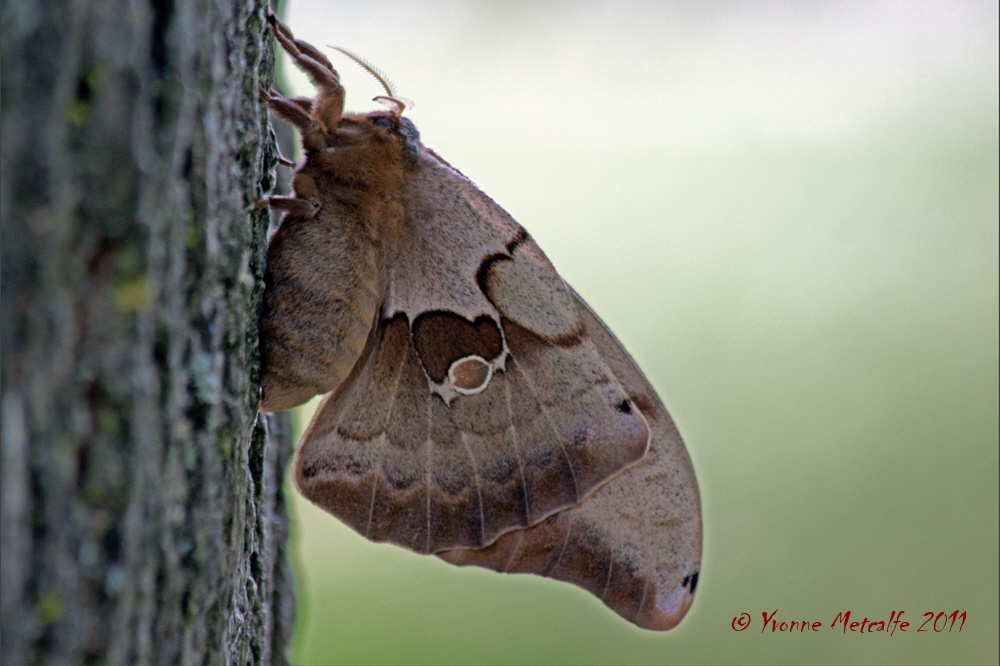
While waiting for my son's soccer game to start, I usually walk the perimeter of the soccer field trying to find something interesting to shoot.  I often come across something worthwhile, whether it be some bees, snails, spiders or pretty flowers.  On one lucky day in the beginning of July, I fould the largest moth I had ever seen.  After some research, I discovered it was a Polyphemus Moth.

The Polyphemus Moth is one of the most widespread silkmoths and ranges from southern Canada southward throughout most of the lower 48 states.  It is a tan coloured moth with beautiful feathered antennae and has a wingspan averaging between 10 and 15 cm.  Now that's a lot of moth!  There is a small eyespot on the outside wing or forewing, which you can see in my photos.  On the hindwing near the middle there is a huge round or elliptical eyespot.  This moth didn't open up its wings for me, so I unfortunately do not have a shot of the impressive hindwing, but images of this can easily be found by googling this moth. 

I had spotted this moth resting on a tree trunk on the outskirts of a soccer field.  It was very patient and let me get very close to it without even moving.  I practically had my lens touching it at times and it never even budged.  Before moving in to get some macro shots, I took several pictures with my telephoto lens just in case the moth flew away with my approach.   Lucky for me it stayed!  Enjoy!!

A top down look at a Polyphemus Moth.  I was resting my camera on the tree for stability


Click the photo for a larger view!


Friday, July 8, 2011

Enter The Dragonfly

The other day, along the Ottawa River, I had the distinct pleasure of witnessing the metamorphosis of a dragonfly.  I have been wanting to see this transformation happen for a long time now, and I certainly wasn't disappointed!

The life cycle of a dragonfly begins as an egg laid in the water.  Once it hatches, the dragonfly lives underwater as a nymph (also called a naiad) for anywhere from one to four years.  Dragonflies are carnivorous as nymphs as well as adults.  During their aquatic stage, the nymph eat water boatmen, snail larvae, other naiads and even small fish.  When the time is right, the naiad will crawl out of the water onto a plant or rock or whatever lends itself as a suitable place, and the final metamorphosis will occur.
This transformation, from nymph to adult dragonfly, is what I finally witnessed the other day.

The dragonfly has pushed through its old skin.  The wings have yet to expand...


The dragonfly is pushing water throughout its body so that all its new appendages take form.
The wings have started to expand slightly...
  
The wings have expanded a bit more, and the dragonfly is now pulling its tail out of its skin some more. 

 
The tail is now completely free from the nymph skin.  This empty skin casing  is called the exuvia. 


More wings.....


Trying a different angle.  The wings have filled in considerably.  This dragonfly had crawled up the retaining wall at Britannia Beach, in case you were wondering. 


With its wings almost completely expanded, the dragonfly waits to dry off and start its new adventures as an adult dragonfly.  Happy mosquito hunting!!!

Saturday, June 25, 2011

Trilliums and Frogs!

A week after my last blog, the trilliums all opened up in abundance.  I spent a good amount of time exploring Wilkin's Walk one day, enjoying the flowers, birds, frogs and sunshine of a perfect spring day.  Getting into nature doesn't always have to involve a trip to the mountains, a drive to a provincial park or a giant hike into the wilderness.  Sometimes it is as simple as taking a stroll down to the lake, walking around a pond or adventuring into your own backyard.  Sometimes you'll be amazed at what you find so close to your own house.

Lucky for me, we live very close to a lake, and there are wooded paths moments from my front door.  Every chance I get, I try to seek out some nature to nurture my soul.  Here are some shots from one of my day adventures.  .  . 


Not sure what this flower is.  Do you?
Don't forget... you can click on the photos to make them bigger!!
A fringed tulip?  Please correct me if I'm wrong!  I kow my bugs better than I know my flowers.

A daffodil explodes into Spring. 


And of course, I had to get some shots of the trilliums!


I switched this to black and white in photoshop. 


One of the cool things about photography is that sometimes you don't even know what you've captured on your camera until you get home and view your shots on the computer. I don't know about you, but now that I'm over 40, my eyesight is certainly not what it used to be. Trying to see every detail through the viewfinder while lining up a shot, or attempting to review pictures on the LCD while outside, for me is often very challenging. On this particular day, I ended up at my favourite frog pond to get some shots of the frogs before going home. I was using my telephoto lens, so that I could get closer shots without scaring off my subject. While shooting one particular frog, I could tell that he had a fly of some sort on its head. I thought "oh, that will make an interesting picture". I fired off a bunch of shots, and changed the angles up and down to try and give different perspectives of my little green friend. On my way home, I kept thinking of all the shots I got of that one particular frog and couldn't help but think that some of them would have turned out pretty cute.


Imagine my surprise and, (honestly), repulsion, when I saw my pictures on the big screen and realized that the poor little frog I was shooting not only had one fly on its head, but was literally covered in mosquitos! I must have taken picutes of this frog for at least 5 minutes. 5 minutes that poor little frog just sat there motionless in the water and just stared at me. Why didn't it simply dunk itself underwater!! I still shudder a bit when I see this photo! Poor silly frog!


Not all the frogs were covered in mosquitos this day though.  I did manage a shot of one cute fella having a mud bath, and it didn't seem to be bothered by any blood sucking skeeters.  I hope you enjoy my last shot, and perhaps go seek out some flowers, frogs or nature of any kind some time soon. 


Thursday, May 5, 2011

Spring Nature Walk: May 4, 2011

So spring has finally sprung here in Barrie.  Although it officially arrived March 20th, it really hasn't felt like it until now.  With my camera in tow, I managed to get out yesterday for a nature walk to see what the warmer spring weather has awakened in the woods.  With a little patience and a keen eye for the little things, I was quite pleased with some of the small wonders I discovered along the way.

My first stop was at Lover's Creek, just off of Country Lane.  I am new to this path, and need to do some more exploring.  It looks like it is a nice spot, especially for birds and birders, but navigating your way through it so far has been a bit challenging due to a lack of a good path.  Perhaps there is a better place to access this area, but I haven't found it yet.  Here there are plenty of geese, ducks and red winged black birds.  I managed a few shots of some Canadian Geese before receiving a call from my son at school.  Apparently I had given my eldest the wrong hot dog!  His had mustard on it, and apparently wiping the mustard off the weiner was not an option.  Just as well... my tea had worked its way through me quicker than expected.   So home I went to make a quick sandwich, use the facilities, and then head off to another wooded path.


Canada Geese at Lover's Creek, Barrie, Ontario

My next, and favourite destination is the Wilkin's Walk nature path found just off Crimson Ridge.  It's a well groomed path through the woods that leads down to Kempenfelt Bay.  A few frog ponds can be found in this area, as well as a wonderful little creek that empties into the bay. 


The frog pond just off of Crimson Ridge was jumping with activity on this day.  As I walked around the small pond,  frogs plipped and plopped back into the water at the sound of my approach.  One frog, however, did not flinch and retreat.  Instead, he sat there motionless as I snapped off a few shots with my telephoto lens.  Thanks Mr. Frog! 

A green frog at the Wilkin's Walk frog pond

The red-winged black birds were also very aware of my presence, and one bird in particular made himself known to me ~ warning me to stay away.  Protecting their nests, both the males and females erupted into squawks if I came too close.  I managed a shot of the male red wing who was standing his ground.  I have yet to see one of the nests... but they are usually very well hidden among the reeds in the pond. 


Red Winged Black Bird

After walking around the pond a couple of times, I always make time to get some shots of the blooming pussy willow tree.  I was pleased to see that all sorts of bees and wasps were already out enjoying this tree as well.  Well ~ mostly pleased, as I am rather terrified of these creatures.  But I have found that the more I try and shoot them, the less frightened I have become.  I do find it a bit more daunting shooting macros of stinging instects with my Rebel, as I have to use the viewfinder to frame my subject, instead of my LCD.  I could switch my camera to a live view mode, so that the LCD is engaged, but with my poor eyesight, combined with the glare from the sun on the LCD, it would really be a waste of time and batteries.  Eitherway, with the occasional panic attack of not knowing where the bee went combined with a few too-close-to-my-ear fly bys, I did manage a few sting free (touch wood) shots of pollen covered bees foraging for their lunch. 


Click on the pictures to get a larger view!

Upside down dinner

Too busy to notice me.....

After circling the frog pond a couple of times, I was ready to move on to the woods.  A short path takes you to Chicken Beach, where all sorts of different folks go to walk, relax, play with their kids, swim, and feed the ducks.  Oh... and take pictures.  


During my walk up through the woods, I noticed that the trilliums are almost ready to blossom.  Perhaps only a few more days for that!  Near the top of the path, close to where there is a little park for this kiddies, I found some flowers worth taking some shots of. . . . . .  


A daisy of some kind??  Do you know what it is?


 I am not entirely sure what these flowers are. I know more about insects than I do flowers. If you happen to know what these are, please let me know!


For some finishing shots, I'll leave with some macos of the pussy willows, minus the insects.  Click on the photos to make them bigger! 


  Now it's time to go find some nature of your own!  Get out there and enjoy some nature!